In this guide, our team answers some of the most common questions we’re asked at The Clinic to help you understand the treatment before deciding whether it’s suitable for you.
What is botulinum toxin?
It’s a prescription-only medicine (POM), which means it should only be prescribed by qualified medical professionals. It’s a purified protein from Clostridium botulinum bacteria and is used for softening expression lines – forehead creases from expression, crow’s feet from years of smiling and squinting, vertical lines between your brows. It can also be used for grinding, jaw tension, or to lift and refine brow shape.
In the UK, there are several licensed brands including Bocouture®, Botox® and Azzalure®. They all use a similar active ingredient but in slightly different formulations.
How does botulinum toxin work?
Without getting too technical, it temporarily reduces the activity of specific muscles by blocking the release of a chemical messenger. This messenger normally carries signals from nerves to muscles to make them move. When the messenger is blocked, movement is paused. As a result, the appearance of lines gradually softens.
When administered correctly, the surrounding tissue and facial sensation remain unaffected.
How long does botulinum toxin take to work?
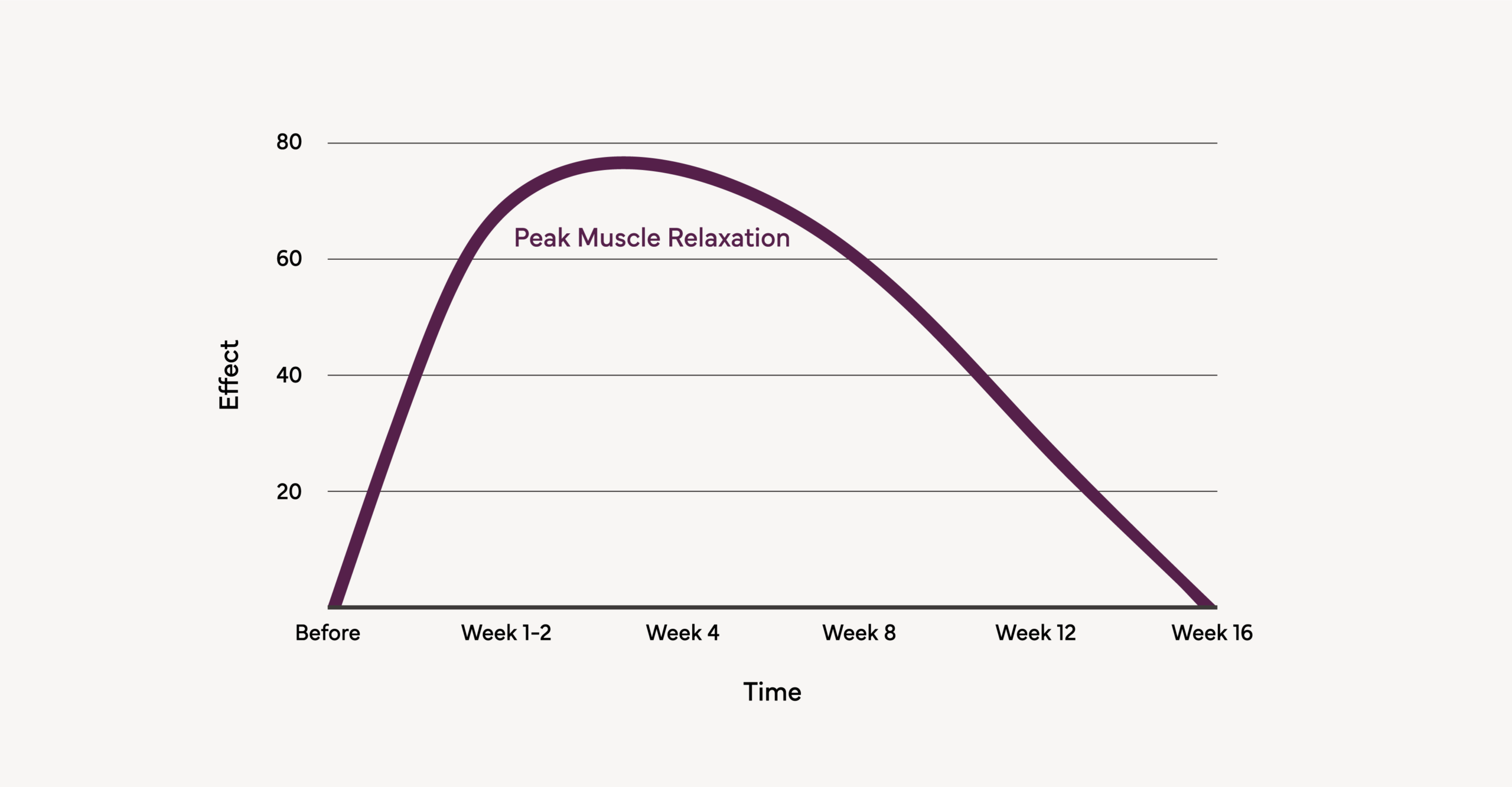
Most people notice gradual (rather than abrupt) changes within a week to 14 days.
Signs of reduced movement tend to become noticeable around day seven. Results are at
their peak from 14 days after treatment.
How long does it last?
The effects of botulinum toxin are temporary. Most people find that results remain visible for three months. The exact duration is different for everyone and depends on the area treated, the strength of the underlying muscles and the way an individual responds to the treatment. For some people, the effect may wear off a little sooner.
Over time, the nerve endings naturally regenerate and muscle activity gradually returns. As this happens, lines and expressions reappear.
How often can botulinum toxin treatment be repeated?
Most clinicians recommend waiting at least three months between treatments. This gives the nerve endings time to recover. More frequent treatment may reduce how responsive your muscles are over time.
Do the injections hurt?
Discomfort is usually mild. The needles are extremely fine, and the injections are placed carefully into specific points. People often describe the sensation as a light scratch or a tiny pinprick. It’s manageable and over quickly.
If you’re nervous about needles, say so. Your practitioner can explain each step of the treatment so you understand what’s going to happen and what to expect.
Is botulinum toxin safe?
All medical treatments carry risks, and your clinician will explain these before any procedure. However, serious complications are not common.
If you have questions or health concerns, these can be discussed during your initial consultation.
Can it cause a headache?
Sometimes. It’s not universal, and when it does occur, it tends to be mild and usually settles with rest or over-the-counter pain relief, if appropriate.
Are there any treatment side effects?
Side effects can occur, although most are mild and temporary. These may include:
- Slight redness
- Tiny bumps at the injection sites
- A feeling of tightness
- Light bruising
- A mild headache
Some people may also notice temporary asymmetry or a heavy sensation as muscles begin to relax.
Serious side effects are rare when treatment is performed by an experienced medical professional.
Can you have treatment when pregnant?
There is not enough research to support safety claims during pregnancy or breastfeeding. As a result, botulinum toxin is not prescribed at any stage of pregnancy. If you’re pregnant, think you may be, or are planning to conceive, mention this during your consultation so your clinician can advise appropriately.
Who cannot have treatment?
Botulinum toxin treatment is not suitable for everyone. During your consultation, your clinician will take a full medical history to make sure the treatment is appropriate and safe for you.
You may not be able to have treatment if you have a known allergy to botulinum toxin type A or to any of the ingredients in the prescribed medicine. It may also be unsuitable if you have certain conditions that affect muscle activity or the way nerves and muscles communicate, such as myasthenia gravis or Lambert–Eaton syndrome.
Treatment will not be carried out if there is infection or inflammation at the planned injection site. Your clinician will also take extra care if you have a bleeding disorder, take medication that affects blood clotting, or have significant muscle weakness in the area being treated.
It’s important to mention any neurological conditions, swallowing difficulties, or previous unexpected reactions to botulinum toxin at your consultation. If you are due to have surgery or have a complex medical history, this should also be discussed so your clinician can advise you properly.
If there is any reason treatment may not be suitable, this will be explained clearly and alternative options can be discussed where appropriate.
What should you avoid after treatment?
After treatment, it is helpful to give the area time to settle so the medicine can work as intended. Most clinicians recommend avoiding strenuous exercise, saunas, steam rooms and hot baths for the rest of the day. Heat and increased blood flow may affect how the treatment settles. It is also sensible to avoid rubbing or massaging the treated areas.
How long before you can lie down?
Around four hours. Staying upright reduces the chance of the medicine moving into neighbouring tissue. Although lying down earlier is unlikely to cause harm, the four-hour window gives the treatment the best opportunity to settle.
How long before you can exercise?
It’s best to avoid exercise for the rest of the day. Activities that raise the heart rate or increase blood flow can influence how the botulinum toxin treatment settles. Gentle walking is usually fine.
Can you drink alcohol after botulinum toxin treatment?
It’s not recommended for the remainder of the day because it may increase the likelihood of bruising immediately after treatment.
How much is botulinum toxin?
The cost of botulinum toxin treatment varies depending on the areas being addressed and the dose required for your needs.
At The Clinic, treatment is available from £225 for one area, with a charge of £325 for a full-face treatment. The final cost will be confirmed after a full consultation and medical assessment with our medically trained team.

Book a treatment
Book an initial consultation so that we can discuss your concerns and the options available. Existing patients are welcome to book additional consultations to discuss further treatment options.